

How to structure your multiple passions
Having multiple things going on doesn't mean you have to appear like a hot mess.


If you’re someone with more than one career trajectory, you’ll understand the feeling of never really knowing which professional title to lead with.
Telling people what you do for work is likely your least favourite thing to do.
You might be frequently consumed by questions such as: Should I try to pursue this or that career? How could I combine my multiple passions into one coherent career path? Do I need to put all my focus on one thing or can I spread my energy across different pursuits?
Being multipassionate isn’t easy.
In fact, it’s an ever-evolving identity battle where we converse with the different voices in our heads.
And because most of the people we follow on different platforms appear to be really good at one thing, we always feel a little bit different and weird.
But just because we have multiple passions, doesn’t mean we have to live in chaos.
We can structure the way we operate.
Let’s unpack what that structure might look like through an example inspired by my typical clientele.
Let’s look at Vera, who holds a senior leadership position in a climate-conscious company. She’s also an aspiring columnist on zero-waste topics. She also sings in a band and is passionate about bringing musical hobbies to underprivileged children, so her band volunteers at preschools and libraries.
Vera sometimes struggles to decide whether she should keep her day job or go self-employed so she could devote her time more evenly between her passions. She also wonders whether her true purpose lies within the climate movement or the performing arts. Vera is equally puzzled by whether she wants to work for a capitalist company or whether she should pursue a more “socially responsible” role at an NGO.
How should Vera go about structuring her career?
In my point of view, Vera has several options.
Option A: A comfortable income meets purpose-driven hobbies
Vera keeps her job, her columnist sidekick and her volunteering job as is. This is likely the highest-paying option with the least effort and insecurity. She gets a secure monthly income and doesn’t have to worry about making money from the other things she does. The only salesy activities on her plate are a) proposing columns for established media about zero-waste topics and b) contacting children’s organisations about volunteering with her band. The biggest downside to this option is time: having a full-time job with a demanding title and multiple hobbies on the side can be a burden to her wellbeing if not managed with care.
Option B: A purpose-driven portfolio career
Vera goes self-employed and divides her time between the two causes she cares about. She consults companies on sustainability issues (a high-paying gig) and works two days a week for a non-profit focused on music education for underprivileged children (a lower paying gig). Because the consultancy is her main source of income, she spends half a day a week promoting herself on LinkedIn and writing opinion pieces on sustainability topics (this is where her existing column fits in perfectly). The non-profit job doesn’t require self-promotion so she doesn’t have to do more than show up for it. In this scenario (if she’s smart about it), Vera can squeeze all her different passions within the scope of a regular workweek and has more free time. Her income might be equivalent to Option A or a little more or less, depending on what Vera charges for her consultancy.
Option C: Turning the purpose into a comfortable income
If Vera wants her passion for music education job to become the main event, she could try to pursue a more substantial income opportunity in that field.
It would likely require her to, for example, start a foundation focused on music education for underprivileged children or create a business that would deliver value to existing organisations that share the same mission.
Both avenues would require a fair amount of effort but could provide meaningful returns in the long term.
If Vera still feels like she also wants to stay involved in the sustainability space, she could keep her columnist gig, assuming it’s no more than a monthly submission. This gig wouldn’t be irrelevant to her main pursuit in children’s musical education since it could 1) help her establish relationships with media outlets (which can be helpful once she has something she wants to launch) 2) help her stay connected with her network in the sustainability space (which could offer surprising avenues for fundraising etc) 3) add to her brand as a changemaker and make her stand out from others in the industry.
As seen above, Vera has several options. If I were to work with her, I’d likely find options D and E, too. There are countless ways to design careers around one’s passions.
Once Vera would feel satisfied with her options, the next step is a game of elimination, i.e. finding obstacles and annoyances that make some options appear less appealing.
Now, it’s important to note that no single option will ever be “better” than another. One option may only be more suitable than the other, considering Vera’s overall life circumstances.
Once the options are mapped out, the only way to really find out what is more suitable is to focus on oneself as a person:
Who are you in relation to this option? How much of yourself and your life’s aspirations can you actualise in this role and/or alongside of it?
So, next, let’s walk through this process of self-discovery step by step.
Step 1: Forget the career for a moment and focus on self-reflection
Before asking more questions about her career, Vera should take a moment to address the broader life goals she has. If you find yourself in a similar situation, here are a few questions to help you move forward.
Ask yourself:
What else do I want my life to be about than work, i.e. do I have life goals such as raising children, caring for my parents, travelling the world, building a house etc?
How much of my time do I want to spend working and how much time do I want to spend on my hobbies/family/just chilling?
What are my financial goals, i.e. am I dreaming of buying a house or taking a sabbatical or spending my retirement living a lavish lifestyle?
What non-negotiables do I have in my current lifestyle that I’m not willing to give up? These could be anything from travelling once a year to buying that fancy granola for breakfast.
How much money do I need a) right now and b) to afford whatever I mentioned above?
Step 2: Understand what type of work serves you best
Ask yourself:
Do I enjoy self-management and maximum freedom to structure my daily life or do I work best when I’m given clear objectives and tasks?
What type of work stresses me out?
What kind of work makes me thrive?
What kind of work is so easy for me that I could do it in my sleep?
Am I happy to think about work all hours of the day if it’s something I care about or would I rather have clear boundaries between work and leisure time?
What kind of acknowledgement (public, private) would I like for my skills and talents?
Step 3: Which tradeoffs are you willing to make?
Ask yourself:
How comfortable am I in taking financial risks?
How comfortable am I in selling myself as an expert?
How long could I be trying something different without becoming financially vulnerable?
How resilient am I if I’m being rejected?
How comfortable am I to give up my free time in order to expand on something I feel passionate about?
When you have multiple passions, solving the career equation isn’t merely a logical exercise. It’s also about how you feel. People who are driven by a passion for something need to have feelings for whatever they pursue. A significant profit margin won’t do the job on its own.
The closer you get to seeing the reality of each option on practical terms, the easier it will be for you to understand your feelings.
So, call that friend who is a business owner, have a chat with that expert who knows the industry you’re considering, or pay that coach who can teach you exactly how to do it. When an idea turns into a realistic plan with thrills and responsibilities, only then will you be able to honestly say which one works best for you.
One final note…
Not all passions are necessary to pursue as jobs. What I mean by this is that sometimes, a passion can be a how instead of a what. I’ll give you an example.
Recently, I came across a Swedish moderator and TV host named Catarina Rolfsdotter. She’s a media professional who has niched into sustainability topics and has 15 years of experience as a yoga teacher.
In her professional intros, she introduces her yoga background as a tone she brings to her work as a facilitator and moderator. It gives her performances a sense of presence and calm. These are characteristics that might make her stand out from other facilitators in the same space. The important thing to notice here is that she’s not selling herself as a yoga teacher but doesn’t either exclude a mention of it from her profile. It’s an additional skill, not a job in itself.
***
I hope this post was useful to you, especially if you’re in a season of wondering how to structure your multiple passions and skills.
Obviously, everyone’s situation is different so never copy-paste anyone else’s career trajectory but create your own.
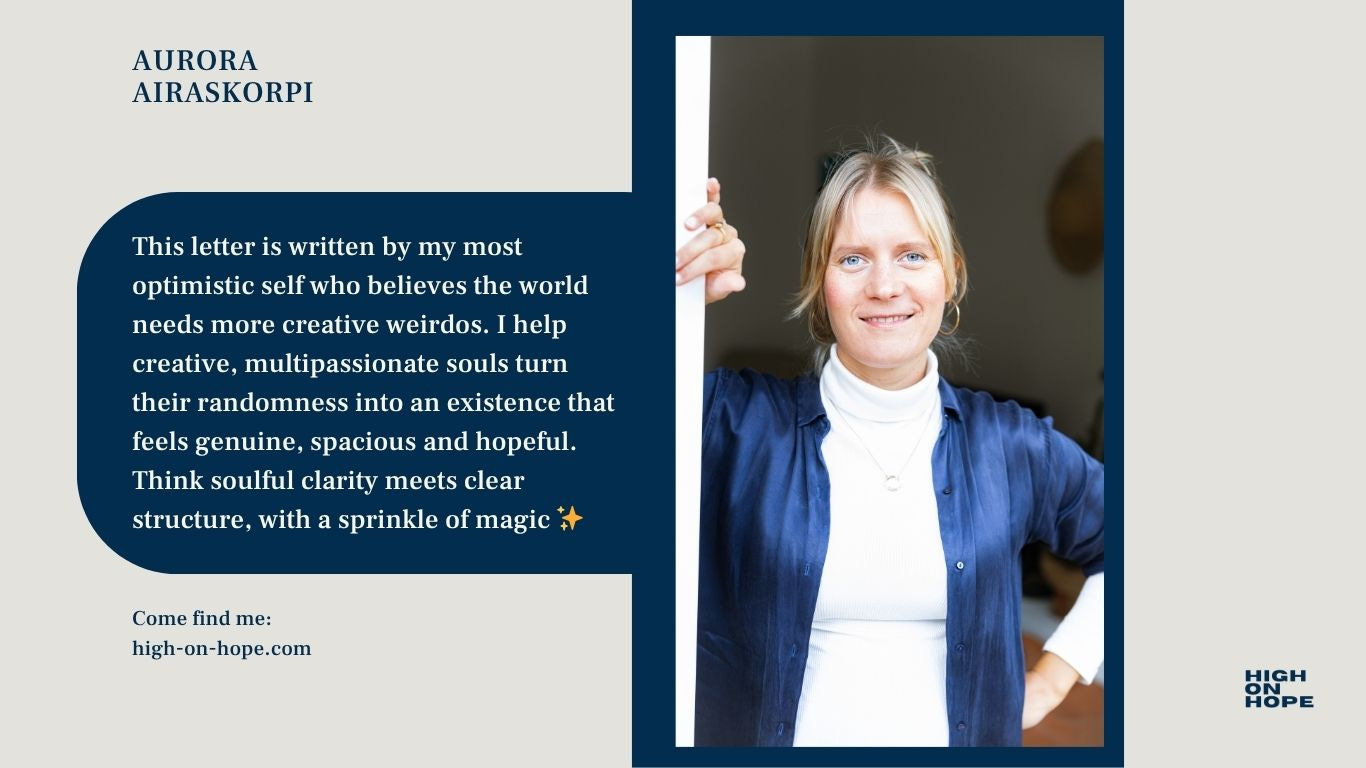
If you’re looking for more personalised help, I’m opening a few coaching slots for the autumn/winter for my Navigation Package. It’s a 10-week collaboration where we align your passions, resources and goals to create structure, coherence and any materials you might need to take the next step in your career. You can read all about it here or send me a PM to schedule a free introductory chat.
Also, if you’re self-employed and have multiple things going on, don’t forget to check out my free resource Chaos-free freelancing. It gives you a bunch of coaching tools to create a sustainable self-employed business.
In the meantime, remember that your randomness is a gift. Keep showing up with all that you are and allow the world to reveal where you’re most needed right now.
With kindness,
Aurora
***


You have no idea how you're sparking some thoughts for quite an anxious person here 🫶 definitely frame my journaling according to key takeaways here!